


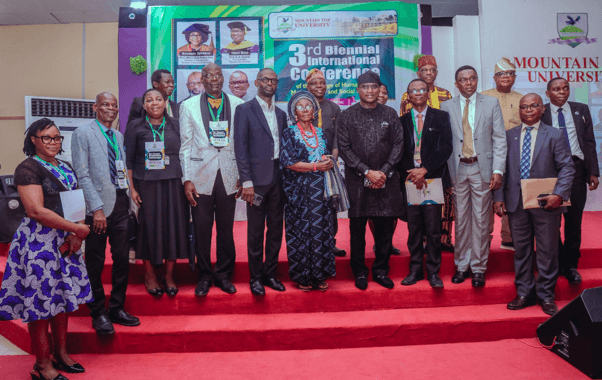
The College of Humanities, Management and Social Sciences (CHMS), Mountain Top University, successfully hosted its Third Biennial International Conference from 23 to 24 June 2026 at the University’s Multipurpose Hall and Conference Rooms. The event brought together eminent scholars, researchers, policymakers, and industry leaders to deliberate on critical issues shaping Nigeria’s future in an increasingly uncertain global environment.
The two-day intellectual gathering attracted participants from various tertiary institutions and private-sector organisations across the country. The conference provided a robust platform for interdisciplinary dialogue, knowledge exchange, and the generation of innovative solutions aimed at addressing Nigeria’s multifaceted socio-economic, political, and developmental challenges.
Distinguished Attendees and Principal Officers
The conference drew a prestigious gathering of internal and external scholars.
Mountain Top University Principal Officers and Staff in attendance included:
Professor Gabriel Ajayi (Deputy Vice-Chancellor, representing the Vice-Chancellor)
Mr. Olufemi Oyewole (Registrar)
Dr. (Mrs.) Helen Akinade (University Librarian)
Professor Edwin Ofudje (Dean, College of Basic and Applied Sciences)
Professor Olanipekun Ojo (Dean of Student Affairs)
Professor Babatunde Oni (Dean of the College of Humanities, Management and Social Sciences and Conference Host)
Professor M. M. Ologundudu (Chairman of the Conference Organising Committee)
Professor Patience Erigbe (Co-Chairperson of the Conference Organising Committee)
Heads of Departments, Directors, faculty members, and administrative staff.
Special Guest Speakers and Presenters included:
Professor (Mrs.) Chris Funke Ifeta (Keynote Speaker) – Professor of Arts Education at Tai Solarin University of Education
Mr. Gbolahan Olojede (Lead Paper Presenter I) – Group Managing Director of Capital BanCorp Plc
Dr. Adeniyi Adeyemi (Lead Paper Presenter II) – Managing Director of Dealclinchers Home Limited and Chairman of REDAN, Ogun State Chapter
A large contingent of scholars, postgraduate researchers, and conference attendees from universities across Nigeria.
Welcome Address and Conference Theme
Delivering the welcome address, the Dean of CHMS and host of the conference, Professor Babatunde Oni, underscored the significance of sustained intellectual engagement in fostering national development and societal transformation. He emphasised that the conference was conceived as a strategic platform for critical reflection, scholarly inquiry, and evidence-based discourse on issues of national importance.
Speaking on the conference theme, “Reimagining Nigeria’s Future: Governance, Innovation, Culture and Social Transformation in a Time of Global Uncertainty,” Professor Oni noted that the gathering was designed to challenge existing paradigms, interrogate conventional assumptions, and stimulate innovative thinking capable of producing practical and sustainable solutions to the nation’s pressing challenges.
According to him, the complexities of contemporary society require collaborative efforts among scholars, policymakers, innovators, and citizens in order to chart a viable path towards sustainable development.
“Over the next two days, scholars and experts will engage in robust intellectual exchanges across a broad spectrum of thematic areas connected to the conference theme. The future we seek cannot be built through isolated efforts. It requires the collective wisdom of scholars, the courage of leaders, the creativity of innovators, and the active participation of citizens committed to the common good,” he stated.
In his remarks, the Chairman of the Conference Organising Committee, Professor M. M. Ologundudu, stressed the urgent need for Nigeria to critically reassess and strengthen the four core pillars highlighted in the conference theme: governance, innovation, culture, and social transformation. He maintained that meaningful progress and sustainable development can only be achieved when these interconnected dimensions are strategically aligned and effectively managed.
Professor Ologundudu observed that the challenges confronting Nigeria are not insurmountable but require deliberate action, visionary leadership, and innovative approaches capable of driving transformative change across all sectors of society.
Institutional Charge from the Vice-Chancellor's Desk
Representing the Vice-Chancellor, the Deputy Vice-Chancellor, Professor Gabriel Ajayi, described the conference theme as highly relevant and reflective of the realities confronting contemporary Nigeria. He stated that the conference presents a unique opportunity for stakeholders to rethink existing approaches to governance and development while envisioning a future anchored on visionary leadership, innovation, ethical governance, cultural confidence, and social advancement.
“The future cannot be built on yesterday’s assumptions,” he remarked. “It demands bold ideas, courageous leadership, creative thinking, institutional resilience, and a collective commitment to national transformation.”
Professor Ajayi further commended the organisers for sustaining a culture of academic excellence and intellectual engagement through the biennial conference series, noting that universities must continue to serve as centres of knowledge production and agents of societal transformation.
Keynote Address: Broadening the Scope of Governance
Delivering the keynote address, Professor (Mrs.) Chris Funke Ifeta challenged participants to broaden their understanding of governance beyond the activities of elected officials and government institutions. She argued that governance is fundamentally reflected in the daily decisions and actions of individuals within classrooms, workplaces, communities, and institutions.
According to her, the quality of governance in any society is largely determined by the collective values, attitudes, and commitments of its citizens. She therefore called for stronger partnerships among educational institutions, community leaders, policymakers, private-sector actors, and civil society organisations in advancing sustainable national development.
Professor Ifeta further observed that Nigeria must transition from a culture of reactive crisis management to one focused on building resilient systems and sustainable institutions capable of addressing contemporary and emerging challenges. She stressed the need for strategic long-term planning, institutional accountability, and policy consistency in driving national progress.
Highlighting the country’s enormous economic potential, she advocated a deliberate shift from the exportation of raw materials to value-added production and industrial development. Such a transition, she noted, would enhance economic competitiveness, create employment opportunities, and strengthen national productivity.
The renowned education scholar also called for comprehensive reforms within the educational sector to promote inclusivity, innovation, digital literacy, critical thinking, and entrepreneurial competencies among learners. She argued that the demands of the twenty-first century require educational systems that equip graduates with relevant skills for a rapidly evolving global economy.
Drawing comparisons with more developed nations, Professor Ifeta noted that while countries with stronger institutions often plan for stability, Nigeria must develop adaptive frameworks that enable it to thrive amid uncertainty and volatility. She identified innovation, decentralisation, cultural resilience, and the country’s youthful population as strategic assets capable of accelerating national transformation.
As part of her recommendations, she urged government and development stakeholders to translate policy frameworks into actionable programmes and measurable outcomes through targeted investments in entrepreneurship, innovation ecosystems, and small and medium-sized enterprises (SMEs), which she described as critical drivers of economic growth and job creation.
Lead Paper Presentations: Economic Realities & Entrepreneurial Grit
In his lead paper presentation, Mr. Gbolahan Olojede provided an insightful analysis of Nigeria’s current economic realities and the implications for national development. He acknowledged the widespread impact of inflationary pressures, economic uncertainty, and declining purchasing power on the average Nigerian, noting that these challenges continue to affect households and businesses across the country.
Despite these realities, he encouraged participants to adopt a solution-oriented mindset and to remain optimistic about the opportunities that exist within the nation’s socio-economic landscape. According to him, periods of uncertainty often create opportunities for innovation, entrepreneurship, and strategic investments capable of generating long-term value.
Mr Olojede urged citizens, policymakers, and business leaders to embrace innovation as a critical tool for national development while emphasising the need for greater transparency, accountability, and responsiveness in governance. He further argued that Nigeria possesses immense human and natural resources which, if properly harnessed, could significantly accelerate economic growth and improve the quality of life for millions of citizens.
Sharing his remarkable entrepreneurial journey, Lead Paper Presenter II, Dr. Adeniyi Adeyemi, captivated participants with a deeply inspiring account of resilience, perseverance, and transformational leadership. He recounted his humble beginnings, including working as a bus conductor during challenging periods of his life to support himself and navigate difficult economic circumstances.
Dr. Adeyemi explained that his entrepreneurial journey began while he was still an undergraduate, when he identified opportunities to solve practical problems through business innovation. He noted that his commitment to hard work, continuous learning, and value creation ultimately laid the foundation for his success as an entrepreneur and business leader.
Addressing participants, he emphasised the importance of developing a problem-solving mentality and cultivating the courage to pursue opportunities despite obstacles and uncertainties.
“Nigeria needs more innovators, collaborators, creators, and solution providers,” he stated. “Every challenge presents an opportunity for innovation. The individuals and organisations that will shape the future are those willing to identify problems and develop sustainable solutions.”
He further encouraged young people to embrace entrepreneurship, creativity, and resilience as essential ingredients for personal and national development, stressing that transformative change often begins with individuals who dare to think differently and act decisively.
The conference subsequently featured a series of technical sessions and paper presentations by scholars from various institutions across Nigeria.