

MOUNTAIN TOP UNIVERSITY ADVANCES SPACE RESEARCH WITH GNSS INSTALLATION, SPACE RESEARCH CENTRE AND INTERNATIONAL PARTNERSHIPS
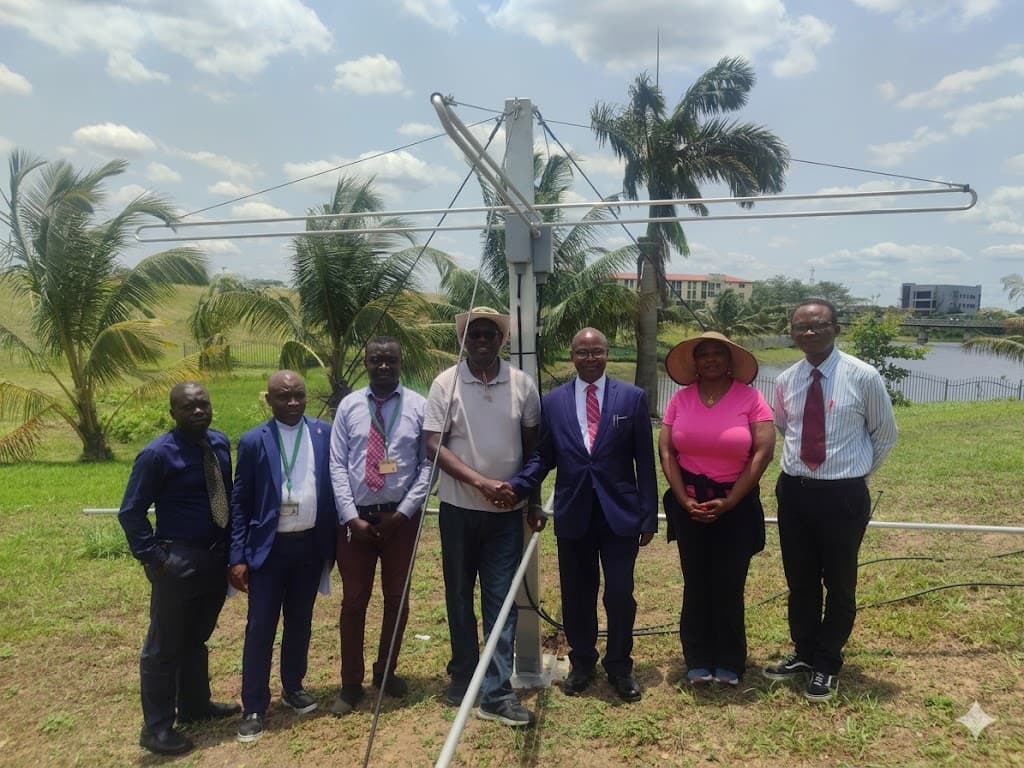
In furtherance of its vision to become a global centre of excellence that combines sound education with the moral development of students, Mountain Top University has, in collaboration with Professor Babatunde Rabiu, Director of the National Space Research and Development Agency (NASRDA), and international partners including the National Institute of Geophysics and Volcanology (INGV), Rome; Abdus Salam International Centre for Theoretical Physics (ICTP); and the Leibniz Institute of Atmospheric Physics, University of Rostock, Germany, installed Global Navigation Satellite System (GNSS) receivers and established a Centre for Space Research.
In this exclusive interview, Professor Rabiu shares insights into Nigeria’s progress in space science, the significance of the GNSS installation, and the future of space research at Mountain Top University.
1. As a Director at NASRDA, how would you assess Nigeria’s progress in space science and atmospheric research over the past decade, and what strategic gaps still need to be addressed?
Tremendous progress has been made in space science and atmospheric research in Nigeria over the past decade. The Federal Government established the Centre for Atmospheric Research in 2013, where I served as the pioneer Director. Prior to this, several universities were already offering graduate programmes in atmospheric science, covering both the lower and upper atmosphere. In addition, courses such as geoinformatics, remote sensing, and GIS are now widely offered across many institutions.
During my tenure, the Centre for Atmospheric Research contributed significantly to infrastructural development, including the installation of air quality sensors, maintenance of weather stations, and deployment of several ionospheric and space weather monitoring systems across more than 20 locations in Nigeria between 2015 and 2022.
More recently, my research team and international partners have established space observatories and laboratories in about five locations across the country, with plans to expand further. Universities are increasingly opening their campuses to host such facilities, while more institutions are introducing programmes related to this field.
However, key strategic gaps remain, particularly in the deployment of diverse monitoring equipment, as well as the provision of stable power supply and reliable internet connectivity at installation sites.
2. The installation of a GNSS facility at Mountain Top University is a significant development. Could you explain the scientific and national importance of GNSS technology?
GNSS is a global navigation system used across multiple sectors worldwide. The receivers installed at Mountain Top University contribute data to global databases, which help improve the overall accuracy of GNSS systems. Each of the two receivers is part of a different global GNSS network.
In addition, the system is used to monitor space weather over Mountain Top University and, by extension, the equatorial region of Africa. Research in GNSS enhances navigational precision and improves the performance of services that depend on it. More broadly, space research helps safeguard space-based assets and the lives that rely on space technologies.
3. What informed your decision to collaborate with Mountain Top University for the establishment of this GNSS station and the Centre for Space Research? What unique strengths or potential did you identify in the institution?
The personality and leadership of the Vice-Chancellor of Mountain Top University played a major role in my decision. He is a scientist with a strong passion for excellence and a deep understanding of the importance of international and industry collaboration in university development. Shortly after assuming office, he initiated discussions on collaboration, which led to this partnership.
The university staff have also been highly cooperative, professional, and supportive throughout our engagements. Mountain Top University is well positioned to attract students from beyond Nigeria into programmes that will benefit from these research facilities and international collaborations.
Additionally, the serene environment of the university is ideal for hosting large-scale research infrastructure. The institution’s leadership is hospitable and strongly committed to global partnerships, while the staff have consistently demonstrated professionalism and responsiveness.
I also believe that these projects will enhance the university’s revenue capacity through increased student enrolment and visits by international students and researchers.
4. This initiative involves collaboration with Professor Jorge Chau of the Leibniz Institute of Atmospheric Physics, University of Rostock. How will this international partnership enhance research quality, capacity building, and global visibility for Nigerian space science, and specifically for Mountain Top University?
The GNSS projects mentioned earlier involve collaboration with two Italian institutions: the National Institute of Geophysics and Volcanology (INGV), Rome, and the Abdus Salam International Centre for Theoretical Physics (ICTP), Trieste.
The collaboration with the Leibniz Institute of Atmospheric Physics, University of Rostock, under the leadership of Professor Jorge Chau as Principal Investigator, focuses on the installation of a meteor radar system at Mountain Top University. This project is currently about 90% complete.
As a result, the university now hosts three major research facilities in partnership with three international institutions, all dedicated to space and geophysical research. The Centre for Space Research at Mountain Top University serves as a global research infrastructure, contributing data to international databases, promoting competitive research, and enhancing capacity building.
There are also plans for student and staff exchange programmes with international collaborators. This development is a significant achievement that will enhance the global visibility and ranking of the university.
5. Looking ahead, what is your long-term vision for the Centre for Space Research at Mountain Top University? How will this facility create research, training, and career opportunities for students and young scientists in Nigeria?
The long-term vision is for the Centre for Space Research at Mountain Top University to become a Global Centre of Excellence in space science and geophysical studies within the next five years.
Within the past year alone, scientists from five countries: India, Ghana, South Africa, Italy, and Germany have visited the facility. A comprehensive five-year strategic plan is currently being developed to outline pathways for creating research, training, and career opportunities for students and staff.
The facility is designed as a global research infrastructure that will be accessible to researchers worldwide.
6. Finally, sir, what are your thoughts for young scientists in Nigeria?
Young scientists should remain hopeful and take full advantage of available opportunities. They must embrace diligence, dedication, and strong mentorship. Above all, scientists at all levels should recognise that science and humanity are inseparable.