


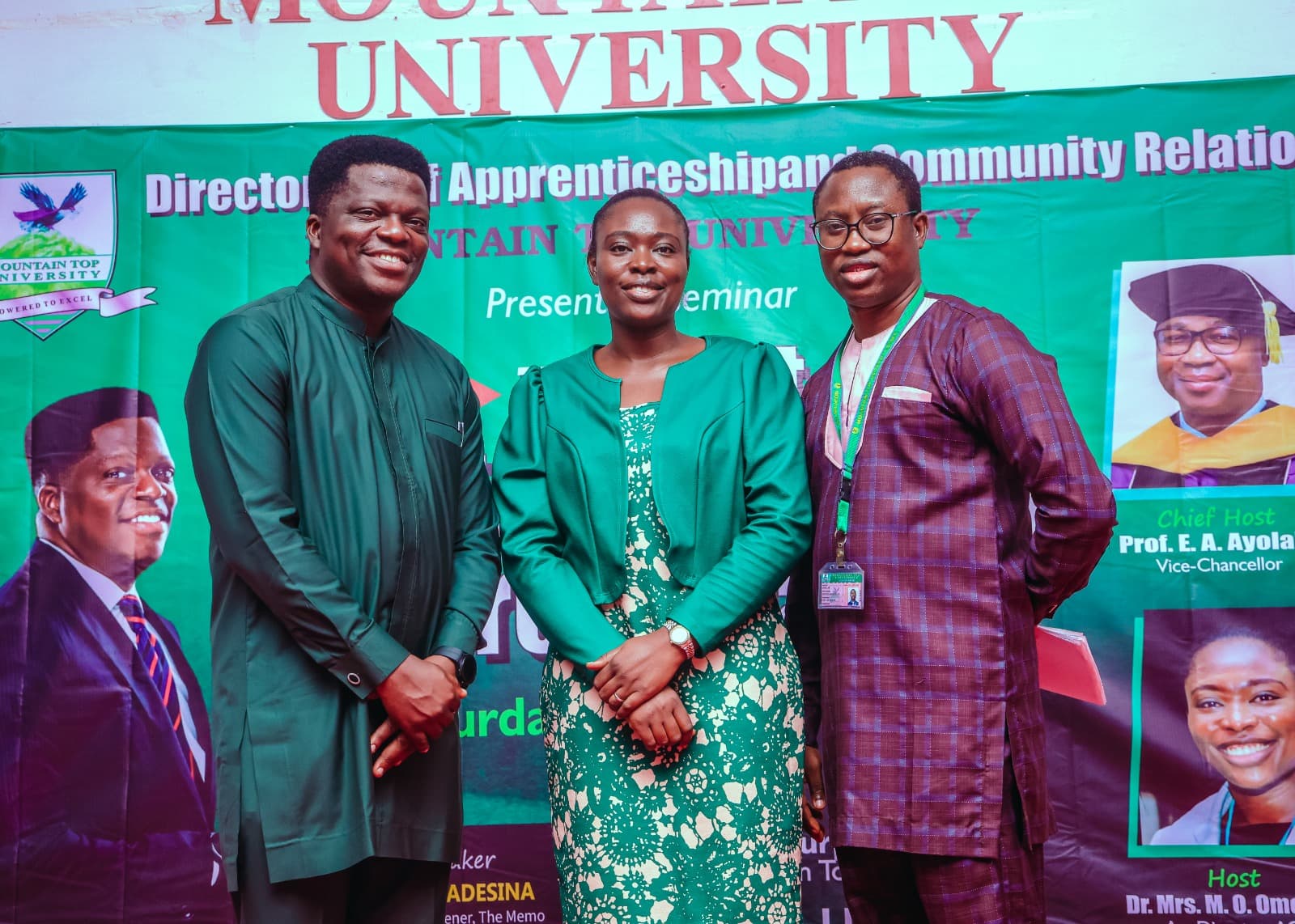
Mountain Top University Empowers Students with Public Speaking and Presentation Skills for Professional Excellence
In furtherance of its commitment to producing graduates who are not only academically sound but also professionally competent and globally competitive, the Directorate of Apprenticeship and Community Relations at Mountain Top University recently organised a capacity-building training programme on public speaking and presentation skills for students.
The training, themed “The Art of Public Speaking and Presentation”, was held on 30 May 2026 under the leadership of the Director of the Directorate, Dr (Mrs) M. O. Omosebi. The initiative was specifically designed to expose students to the principles, techniques, and practical applications of effective public speaking, a skill widely recognised as essential for success in today’s highly competitive professional environment.
Addressing participants during the training, the guest speaker, Mr Olalekan Adesina, underscored the indispensable role of public speaking in personal development, leadership, career advancement, and societal transformation. He described public speaking as life itself and one of the most influential tools for shaping opinions, inspiring action, transmitting knowledge, and driving meaningful change across communities and nations.
According to him, effective communication remains at the heart of human interaction and progress. He noted that individuals, organisations, governments, and institutions rely heavily on the power of communication to influence decisions, build relationships, and achieve their objectives. “Every individual is influenced by ideas, values, and perspectives communicated by others. Public speaking is therefore not merely an activity; it is a vital life skill that shapes culture, impacts society, and influences the course of human development,” he stated.
The communication expert further explained that public speaking is a dynamic art that transcends various fields of human endeavour, including leadership, business, education, governance, entertainment, advocacy, and interpersonal relationships. Drawing parallels with the arts, he described public speaking as a discipline that requires continuous learning, practice, and refinement.
Speaking extensively on the fundamentals of effective public speaking, Mr Adesina identified audience awareness as one of the most critical factors in successful communication. He emphasised that every speaker must develop a clear understanding of the audience’s expectations, interests, concerns, and aspirations before delivering any presentation.
“The true measure of effective public speaking lies in the audience’s understanding, engagement, and response,” he noted. “A speaker must understand the audience’s expectations, connect with their experiences, address their concerns, and deliver messages that resonate with their realities.”
He advised students to conduct adequate audience analysis before every engagement, stressing that a thorough understanding of the audience significantly enhances message delivery and overall communication effectiveness.
Mr Adesina also highlighted the importance of mastering the subject matter of any presentation. According to him, thorough preparation and comprehensive knowledge of the topic being discussed contribute significantly to a speaker’s confidence, credibility, and ability to engage the audience meaningfully.
He further stressed the need for speakers to familiarise themselves with the venue and environment of their presentations ahead of time. Such preparation, he explained, enables speakers to adapt effectively to the setting and optimise their performance.
On personal appearance and stage presence, the facilitator encouraged students to dress appropriately and comfortably while maintaining professionalism. He advised participants to avoid outfits, accessories, or fashion choices that could distract the audience from the core message being communicated.
Encouraging students to cultivate confidence through regular practice, Mr Adesina emphasised that public speaking excellence is achieved through preparation, consistency, and continuous improvement. He urged participants to put everything they had learnt into practice by intentionally pairing themselves and continually practising public speaking.
He cautioned against overconfidence and complacency, reminding students that even experienced speakers devote considerable time to preparation and rehearsal.
The guest speaker also encouraged students to develop their own authentic communication styles rather than attempting to imitate others. While acknowledging the value of learning from accomplished speakers, he stressed that originality, authenticity, and self-awareness remain essential ingredients for building a compelling and memorable speaking presence.
The highly engaging training session concluded with an interactive question-and-answer segment during which students sought expert guidance on overcoming stage fright, building confidence, engaging audiences, improving delivery techniques, and mastering professional presentations.
The training once again demonstrated Mountain Top University’s unwavering commitment to holistic education. Beyond academic excellence, the University continues to equip students with the practical competencies, leadership attributes, and life skills required to thrive in an increasingly dynamic, interconnected, and knowledge-driven global environment.