

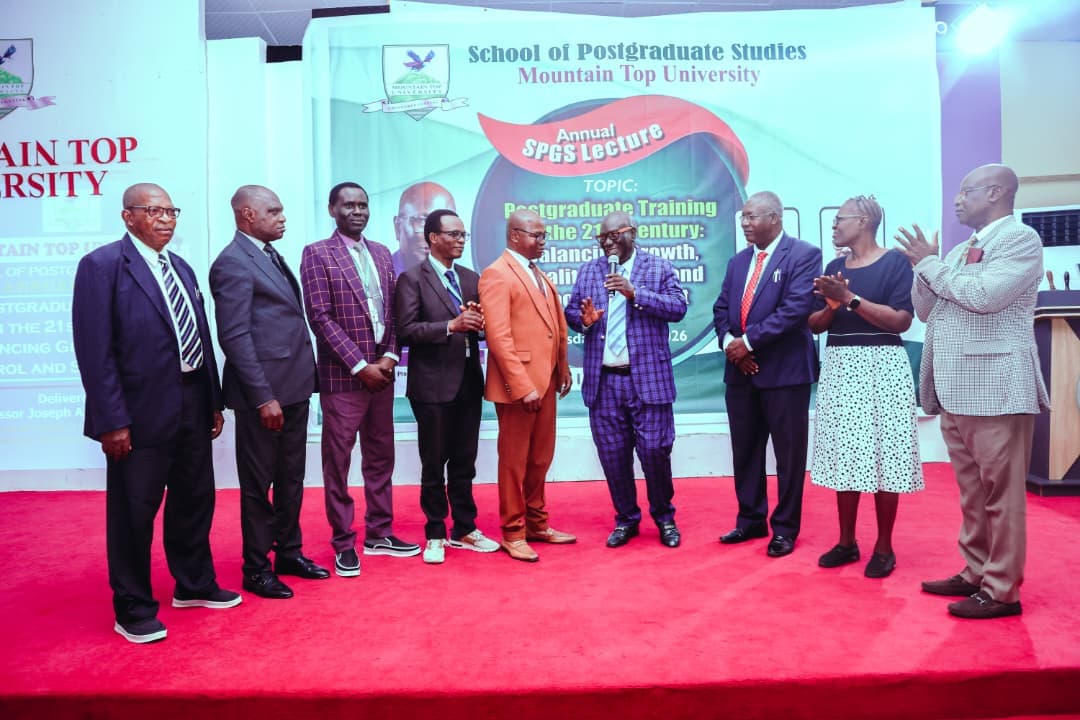
The School of Postgraduate Studies (SPGS), Mountain Top University, on Tuesday, July 7, 2026, hosted its highly impactful Annual Lecture, bringing together eminent scholars, researchers, and postgraduate students for a thought‑provoking intellectual engagement focused on the future direction of postgraduate education in Nigeria.
The annual academic gathering, which served as a platform for critical reflection, examined the evolving landscape of postgraduate education and addressed the pressing challenges affecting research development, academic quality, innovation, and societal impact within Nigeria’s higher education system.
With the theme “Postgraduate Training in the 21st Century: Balancing Growth, Quality Control and Societal Impact,” the lecture provided an avenue for distinguished academics and stakeholders to interrogate existing realities within postgraduate education while exploring sustainable pathways towards building a globally competitive, research‑driven, and impact‑oriented academic environment.
Distinguished Dignitaries and Institutional Leaders
The event attracted notable personalities from diverse academic disciplines, including:
Professor Elijah Ayolabi – Vice‑Chancellor of Mountain Top University (Distinguished Professor of Applied Geophysics)
Professor Gabriel Ajayi – Dean of the School of Postgraduate Studies (Accomplished Professor of Biochemistry)
Professor Joseph Abayomi Olagunju – Vice‑Chancellor of New City University (Guest Lecturer)
Dr. D. T. Otolowo – Sub‑Dean of the School of Postgraduate Studies
Other members of the university’s academic community, including professors, lecturers, researchers, postgraduate students, and stakeholders committed to advancing excellence in higher education.
Opening Remarks: Redefining the Value of Advanced Scholarship
In his welcome remarks, the Vice‑Chancellor of Mountain Top University, Professor Elijah Ayolabi, emphasised the indispensable role of scholarship as a catalyst for societal transformation. He noted that intellectual advancement, research excellence, and knowledge creation remain critical drivers of national development, stressing that universities must continue to serve as centres where ideas are developed, challenges are analysed, and innovative solutions are produced. Professor Ayolabi reaffirmed Mountain Top University’s commitment to sustaining a culture of academic excellence, ethical scholarship, and impactful research. According to him, the responsibility of universities extends beyond the conferment of degrees, as they must actively contribute to solving real‑world problems through meaningful research and knowledge application.
Speaking further, the Dean of the School of Postgraduate Studies, Professor Gabriel Ajayi, described the annual lecture as the beginning of a significant intellectual tradition that would continue to provide a platform for robust academic conversations and interdisciplinary engagement in the years ahead. Professor Ajayi noted that the expansion of postgraduate education globally presents both opportunities and challenges for universities. While acknowledging the increasing demand for advanced academic training, he stressed the importance of maintaining uncompromising standards, ensuring quality control, and preserving the integrity of postgraduate programmes. According to him, the success of a postgraduate institution should not be measured merely by the number of graduates produced but by the quality, competence, and societal relevance of those graduates. He explained that the true value of postgraduate education lies in its ability to produce scholars, researchers, and professionals capable of addressing complex challenges facing humanity.
Also speaking at the event, the Sub‑Dean of the School of Postgraduate Studies, Dr. D. T. Otolowo, highlighted the broader significance of postgraduate education in advancing knowledge and strengthening institutional development. He noted that postgraduate institutions are not simply centres for awarding advanced academic qualifications but are important engines for research, innovation, and knowledge creation.
Main Lecture: The Evolution and Challenges of Nigerian Postgraduate Education
Delivering the main lecture, Professor Joseph Abayomi Olagunju provided a comprehensive analysis of the historical development, present realities, and prospects of postgraduate education in Nigeria.
Tracing the evolution of Nigeria’s university education system, Professor Olagunju highlighted its journey from the establishment of University College, Ibadan, in 1948 by the British colonial administration, which was created primarily to train Nigerians for administrative and professional responsibilities. He explained that university education in Nigeria experienced significant growth after independence, particularly during the oil boom era of the 1970s, when increased national resources supported the expansion of higher institutions. However, he noted that the sector later encountered serious difficulties during the years of economic restructuring, inadequate funding, declining academic standards, and institutional challenges between 1984 and 1999.
Despite these historical challenges, Professor Olagunju acknowledged the resilience of Nigeria’s higher education system and its continued importance in national development. However, he warned that several fundamental issues inherited from previous decades remain unresolved and continue to affect the quality and international competitiveness of postgraduate education.
Key Challenges Currently Confronting Postgraduate Education in Nigeria:
Inadequate research funding
Unfavourable supervisor‑to‑student ratio
Outdated academic curricula
Concerns surrounding degree credibility
Unethical research practices (such as ghost authorship)
Limited research infrastructure
Gender disparities
According to Professor Olagunju, the country’s postgraduate education system must undergo a fundamental transformation from a qualification‑oriented structure into a research‑driven, innovation‑focused, and problem‑solving academic ecosystem. He advocated greater investment in digital transformation, modern research methodologies, interdisciplinary collaboration, innovative teaching approaches, stronger quality assurance frameworks, effective supervisor training, ethical mentorship practices, enhanced industry partnerships, and translational research capable of converting academic discoveries into practical solutions for societal advancement.
Strategic Recommendations for Reform
Concluding his presentation, Professor Olagunju outlined targeted, strategic recommendations for key stakeholders:
For Government and Regulatory Agencies
Establish a National Postgraduate Excellence Fund (NPEF): The Federal Government should create this fund to provide competitive, peer‑reviewed research grants aligned with national development priorities.
Mandatory Institutional Reporting: Introduce the mandatory publication of institutional research output reports annually to promote transparency, accountability, and measurable academic performance.
Strengthen NUC Accreditation: The National Universities Commission (NUC) should strengthen postgraduate accreditation processes by introducing more rigorous evaluation procedures, independent assessment panels, and periodic verification exercises.
National Digital Library Infrastructure: Develop a nationwide digital library network to provide registered postgraduate students across Nigeria with improved access to global academic resources.
For Universities and Schools of Postgraduate Studies
Strictly adhere to approved supervisor‑to‑student ratios.
Periodically review postgraduate curricula in consultation with industry and community stakeholders.
Strengthen institutional research ethics mechanisms and adopt advanced plagiarism detection systems.
Establish comprehensive welfare and mental health support structures for postgraduate students.
For Postgraduate Students
Embrace the responsibilities associated with advanced academic training by developing strong scholarly identities.
Build international research networks and maintain a deep sense of intellectual curiosity.
Demonstrate an unwavering commitment to academic integrity.
Conclusion
Professor Olagunju concluded his lecture by commending Mountain Top University for its dedication to academic excellence, describing the institution as a growing community of scholars united by a shared commitment to knowledge advancement, innovation, and service to God and humanity.